
Won the Load? The Oversize Permit Checklist Before the Wheels Roll
Before the wheels roll: measure the loaded truck, find which limit it is over, give the permit office your exact truck data, check the route, escorts and travel window, then read the finished permit against the trailer. Skip one step and the permit may describe a different load than the one you are hauling.
I've been getting permits into drivers' hands since September 2006, and most of the trouble I see starts in the hour after the load is booked, not on the road. The rate confirmation is signed, the pickup is tomorrow, and nobody has asked the question that decides everything: what will this truck measure, fully loaded, as it rolls? This is the checklist I would hand a dispatcher in that hour. I've used Texas as the worked example because its state agency publishes its limits and thresholds in plain numbers, and I checked every figure against the source.
In this article
- Measure the loaded combination, not the freight
- Find out which limit you are over
- Gather the truck data the permit is written on
- Decide what the permit has to cover
- Count the escorts before you promise the pickup
- Check the travel window and the closure list
- Read the permit against the trailer before you roll
- Know who to call when something changes
- Questions drivers ask us
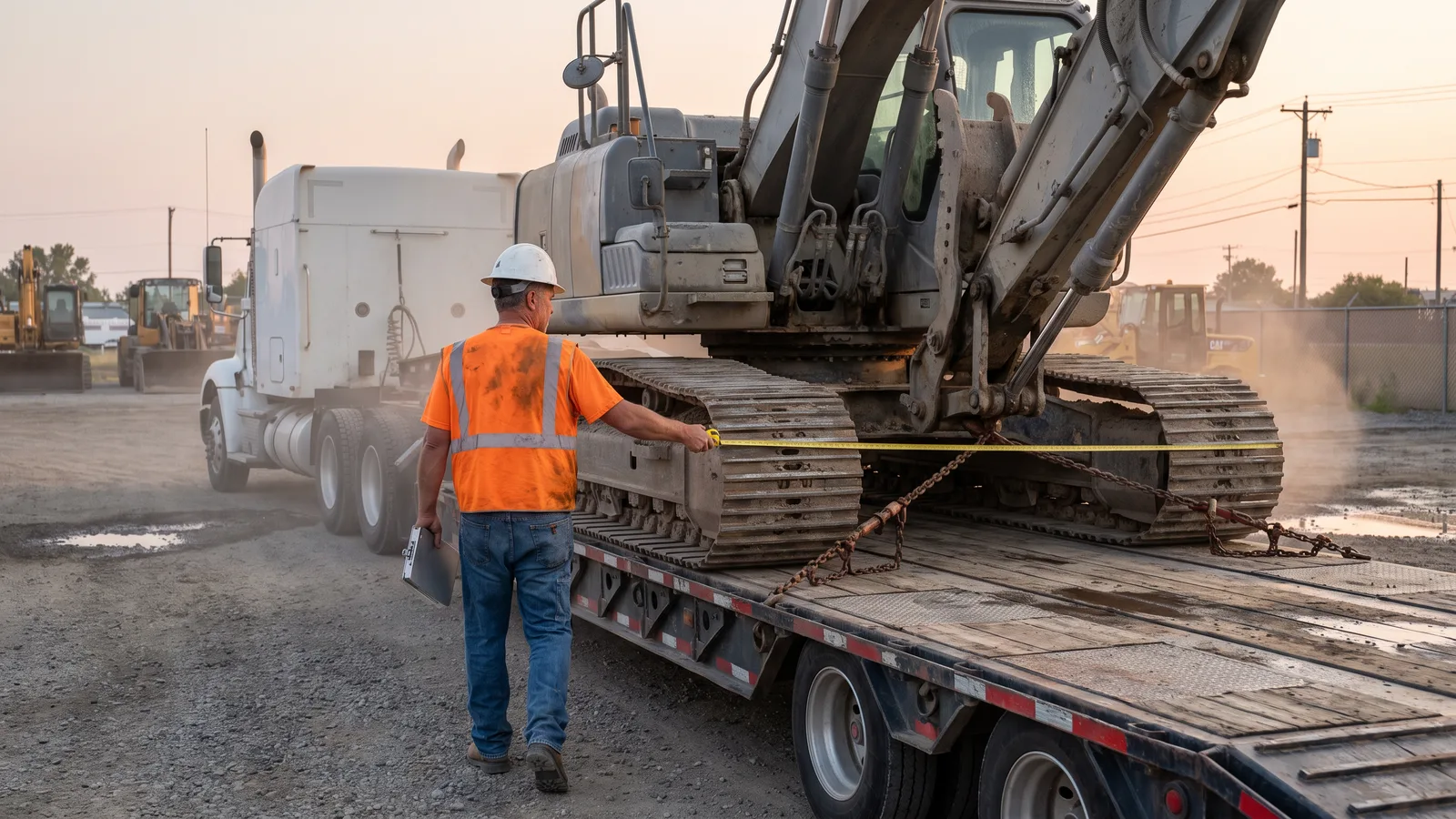
1Measure the loaded combination, not the freight
The number on the bill of lading is the freight. The number on the permit is the whole truck: the widest, tallest and longest point of tractor, trailer and load together, plus anything that hangs off it. Tracks, tarps, mirrors, a boom rest, a bucket, a pallet the shipper added after the order was written.
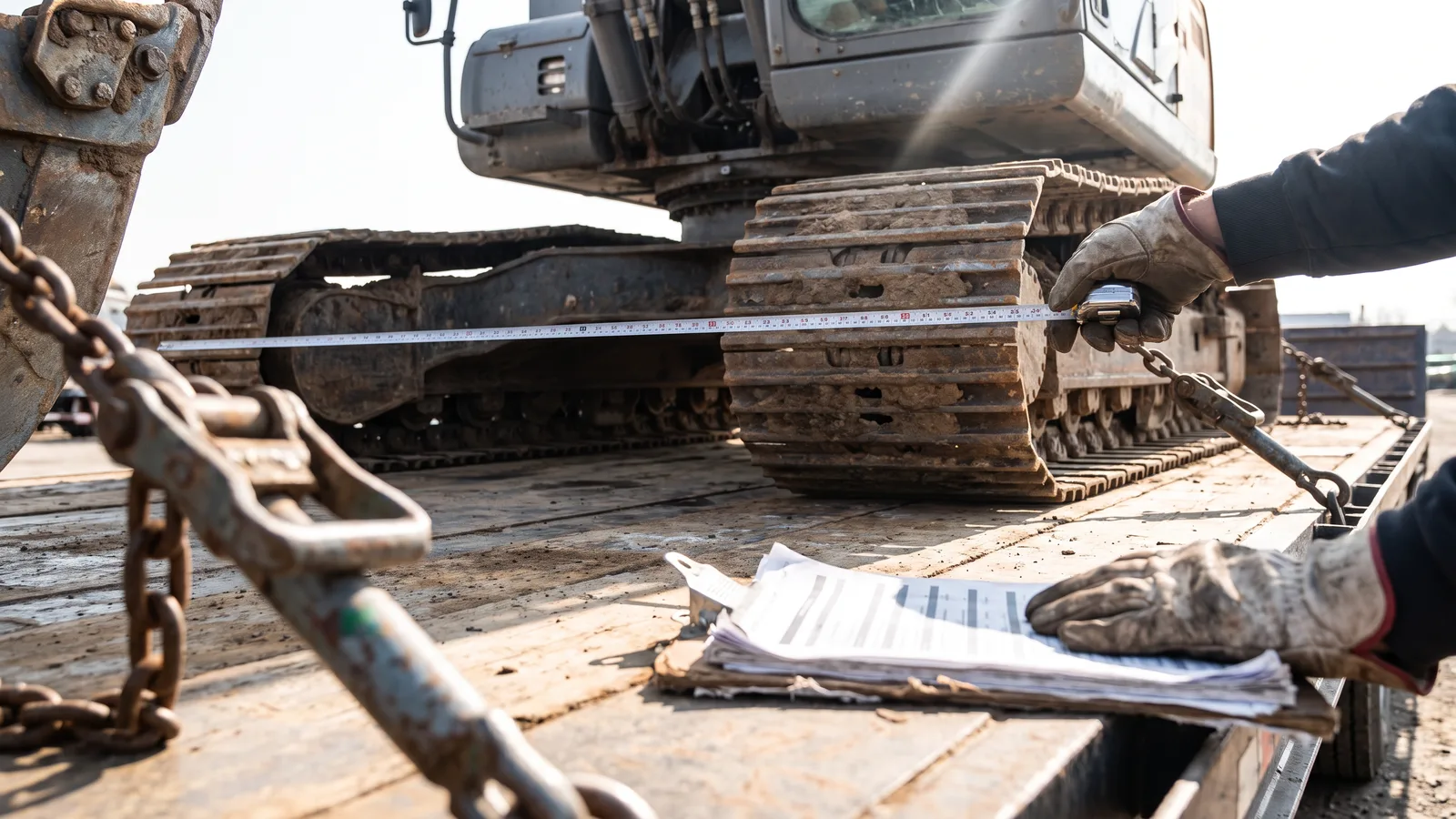
Get the loaded numbers before you order, not after, and get them from the load itself. If the shipper quotes you dimensions, ask whether they include the equipment on the trailer deck and whether the machine will sit the way it was measured. Then put a tape on it. A load that is "about eight foot ten" is a permit for a different width than one that is nine feet.
Two numbers drivers forget: overhang past the rear of the trailer, and axle spacing. Weight permits are written on both. If you are overweight, the permit office needs to know how that weight sits on the axles, not just the total.
2Find out which limit you are over
You are legal without a permit until you cross a line, and the line depends on the state. Federal rules set a floor on some measurements and leave others to the states. Here is how that looks in Texas, with the federal rule beside it.
| Measure | Legal without a permit in Texas | The federal rule |
|---|---|---|
| Width | 8 ft 6 in | States may not set a limit other than 102 inches on the National Network, though a state may grant special-use permits above it |
| Height | 14 ft | No federal height limit; most state limits run 13 ft 6 in to 14 ft |
| Length | 59 ft for a semitrailer in a two-vehicle combination | A state may not set a semitrailer limit under 48 ft |
| Gross weight | 80,000 lb | 80,000 lb maximum gross vehicle weight |
| Single axle | 20,000 lb | 20,000 lb |
| Tandem axles | 34,000 lb | 34,000 lb |
Two things follow from that table. First, height is the one that changes at the state line. There is no federal height limit, so a load that is fine in one state can be a permit in the next. Second, one inch over is over. The permit is not for "a little wide." It is for the exact figure you measured, in every state the load crosses.
Cross-check your answer against the lowest limit on the route, not the first state's. Our travel restrictions guide covers how the rules shift state to state, and the oversize versus superload post explains where an ordinary permit stops and the heavy-haul process starts.
3Gather the truck data the permit is written on
A permit is issued to a specific truck. Before you call anyone, have the following in front of you:
- Your USDOT number. Texas, for one, checks it against FMCSA's records for out-of-service orders before it issues a permit.
- The tractor and trailer: plates, and the VIN of each. A VIN is 17 characters. Read it off the vehicle or the registration, not from memory.
- Axle count and axle spacing, front to rear, for the combination as it will run.
- Overall width, height, length, overhang and gross weight, from step 1.
- Where the load starts, where it ends, and the day you plan to leave.
This is the step we spend our own effort on. When your dimensions arrive by email, our system reads them straight into the order in about twenty seconds, so nobody retypes a VIN on the way in. When you call, our phone system prompts the agent if a dimension hasn't been captured yet. That helps, but you can help it: a driver who has the numbers ready makes a short call.
If you are heavy, say so up front. In Texas a load over 200,000 pounds also needs a certificate of weight from the shipper, and a load over 254,300 pounds, over the maximum axle weights, or over 200,000 pounds on less than 95 feet of axle spacing is a different permit entirely. You want to learn that before the pickup, not at it.
4Decide what the permit has to cover
A single-trip permit is a one-way promise. In Texas it may only be used for one movement, during the times on the permit, from the origin to the destination written on it. Pick up a second load, change the destination, or take a different road, and you are no longer inside the promise. Our post on how permits get voided walks through exactly how that goes.
For the route, three questions:
- How many jurisdictions? Every state the load crosses issues its own permit, and in many places counties and cities do too, for the last stretch off the highway.
- What is the limiting point? The lowest bridge, narrowest lane or tightest weight posting on the route decides what you can run. A GPS built for passenger cars will not know about it.
- Does the load need a route survey? In Texas, a route inspection certification has to be on file before a permit is issued for a load over 20 feet wide, 18 feet 11 inches high, or 125 feet long. Those thresholds are Texas's, and other states set their own, so ask early.
If the route is the hard part, that is what our route consulting desk is for. If the load is heavy or wide enough that an ordinary permit won't cover it, start with superload permits. If you are only passing through a state where you aren't apportioned, you may need a trip or fuel permit as well. And for the full process in one state, our Texas oversize permit guide goes deeper.
5Count the escorts before you promise the pickup
Escorts are a cost and a scheduling problem, and the permit decides how many you need. Texas publishes its triggers in a table, and they are a good picture of how this works:
- Width: over 14 feet up to 16 feet, one escort, in front on two-lane highways or behind on multi-lane. Over 16 feet, one front and one rear on all roads.
- Height: over 17 feet, a front escort with a height pole. Over 18 feet, front and rear escorts on all roads.
- Length: over 110 feet up to 125 feet, one escort. Over 125 feet, front and rear.
- Overhang: a front or rear overhang over 20 feet requires a rear escort.
Texas adds that if a load exceeds the requirements in two dimensions, it needs front and rear escorts. Other states set the lines elsewhere, and some require pilot-car drivers to hold that state's certification. Our pilot car requirements guide covers the differences, and if you need the cars themselves, the pilot car desk matches count, placement and certification to the permit.
Flags and signs belong here too. Texas requires 12-inch red flags marking the extremities of a load that extends beyond the sides of the vehicle or more than four feet past the rear, and its escort vehicles carry an OVERSIZE LOAD or WIDE LOAD sign. Check that the flags and the sign are in the cab before the shipper's dock, not after.
6Check the travel window and the closure list
An oversize permit is good only inside the hours and days written on it. Many states limit oversize movement to daylight, bar wider loads on weekends, set curfews around big cities, and close the road around holidays. Those restrictions are not the same from one state line to the next.
Look at the calendar before you promise a delivery date. A load picked up Wednesday afternoon ahead of a holiday weekend may not have a legal day to run before it. Our holiday closure list puts the restrictions side by side, and it is the first place I'd look. For the year-round rules, see the travel restrictions guide.
7Read the permit against the trailer before you roll
Every permit we process goes to you automatically the moment it is issued, so there is no wait between approval and the cab. That is the moment to read it, with the truck in front of you, before you leave the yard.
- Plate and VIN on the permit match the tractor and trailer you are actually hooked to.
- Width, height, length and weight on the permit are at least what you measured.
- The route is the route you intend to drive, in order, with the roads you expect.
- The dates and travel hours fit your plan, and the permit has not already started to run out.
- The escorts, flags and signs listed are the ones you have.
Any mismatch is a one-minute phone call before you leave the shipper, and a very different call from the shoulder.
If you ever need a permit, click to call.
A specialist picks up. Oversize, overweight, superload, trip and fuel permits in every U.S. state and Canadian province.
Call (888) 949-42208Know who to call when something changes
Something will change. The shipper loads a day late, a road closes, the machine goes on sitting a different way. Call early. Most states will amend a route or extend dates if you ask while the permit is still live, and a permit that has run out is a new permit.
That is why the phone is how most of our customers order. They get the first state, start rolling, and call from the road for the next. We know the local gotchas because we have worked them since 2006, and we answer the phone because that is the work.
Questions drivers ask us
What do I need before I apply for an oversize permit?
Your USDOT number, the plate and 17-character VIN of the tractor and trailer, axle count and spacing, the overall width, height, length, overhang and gross weight of the loaded combination, and the origin, destination and start date. Measure the loaded truck, not the freight.
When does a load need an oversize permit?
When it exceeds the legal limit for width, height, length or weight in any state it crosses. In Texas, for example, that is more than 8 feet 6 inches wide, 14 feet high or 80,000 pounds gross. Federal rules fix the width at 102 inches on the National Network but set no height limit, so height varies by state.
Do I need a route survey?
Only for very large loads, and the thresholds are set by each state. Texas requires a route inspection certification on file for loads over 20 feet wide, 18 feet 11 inches high or 125 feet long. Ask the issuing state early.
How many escorts does my oversize load need?
It depends on the state and the dimensions. In Texas, a load over 14 feet wide up to 16 feet needs one escort, and over 16 feet needs front and rear escorts. If a load exceeds the requirements in two dimensions, it needs front and rear escorts.
Can I get a refund if the permit has the wrong numbers?
Usually not. TxDMV, for one, says a permit fee is not refunded after the permit number is issued, except to correct an error by the agency. Confirm your measurements before you order.
Sources
Rules checked October 19, 2026. Penalties change, and the permit in your cab plus the issuing state's current rule are always the final word.
- TxDMV, Texas Size and Weight Limits
- TxDMV, General Single-Trip Oversize/Overweight Permit
- TxDMV, Escort and Equipment Requirements
- FHWA, Federal Size Regulations for Commercial Motor Vehicles
- 23 CFR 658.15, Width (Cornell Legal Information Institute)
- 23 CFR 658.17, Weight (Cornell Legal Information Institute)
- 23 CFR 658.13, Length (Cornell Legal Information Institute)