

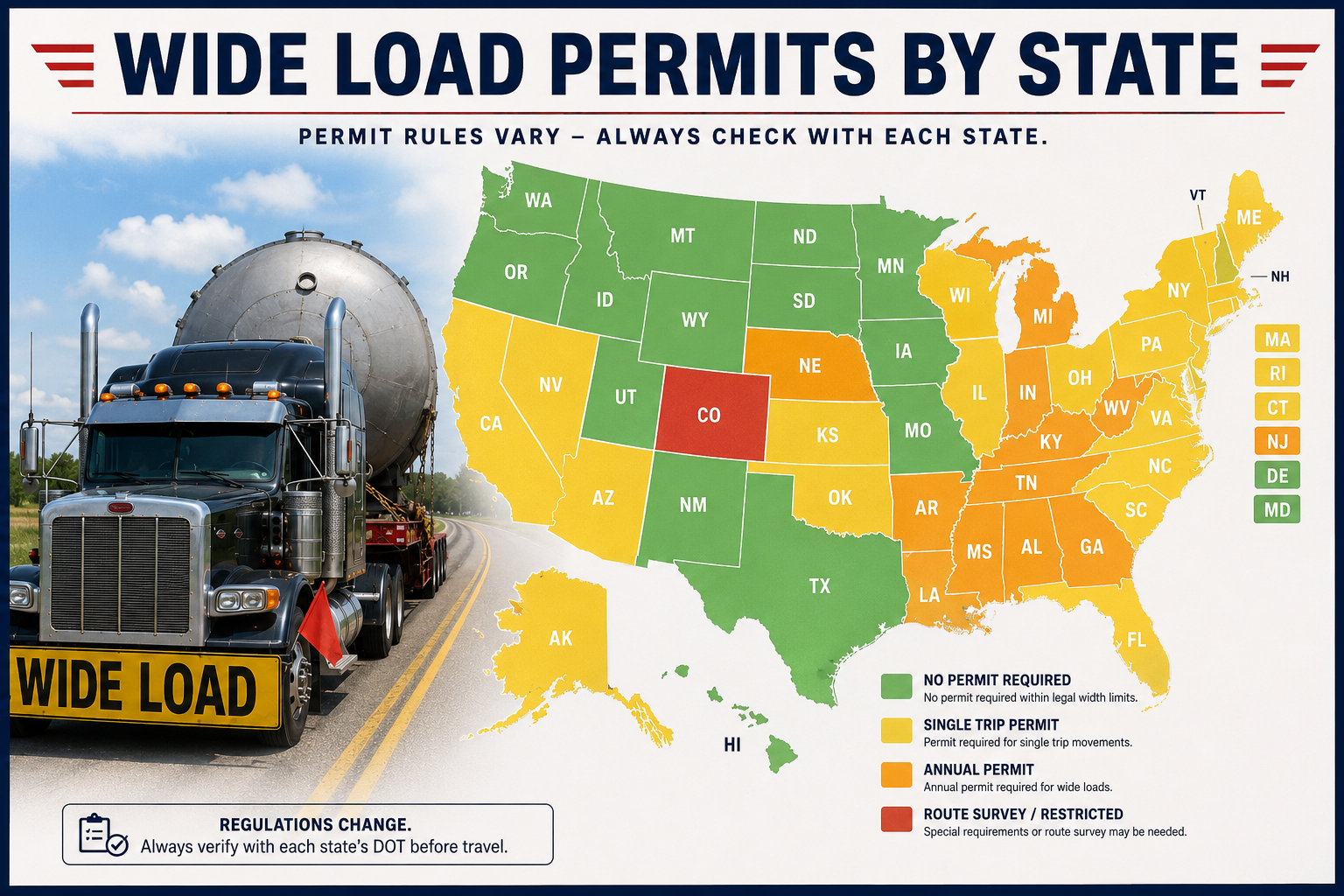
Wide load permits by state are not a one-size-fits-all solution. Every U.S. state and Canadian province has its own rules covering dimensional thresholds, permit fees, travel hour restrictions, pilot car requirements, and route approval processes. For carriers operating across state lines — which is most oversize freight — this patchwork of regulations is one of the most challenging aspects of the job.
This guide provides an overview of how wide load permit requirements vary across key states and why working with a national permit service is the most reliable way to keep your multi-state moves compliant and on schedule.
Why Wide Load Permits Differ State to State
Each state has the authority to set its own size and weight regulations for vehicles traveling on state-maintained roads. While federal law sets baseline limits for Interstate highways, states are free to establish stricter rules for their own road networks. Differences exist across:
- Width, height, length, and weight thresholds that trigger permit requirements
- Maximum dimensions allowable under permit (what states will and won’t authorize)
- Hours of travel (some states allow nighttime oversize travel; others prohibit it entirely)
- Pilot car requirements triggered at different dimensional breakpoints
- Fee structures and permit processing timelines
- Annual permit availability versus single-trip only
Understanding these variables across your entire route — not just the origin state — is essential. Navigating the complexities of trucking permits is something Reliable Permit Solutions handles for carriers every day.
Wide Load Permit Overview: Key States
Texas
Texas allows a maximum permitted width of 20 feet under certain conditions. TxDOT offers both single-trip and annual permits through its online portal, with permit fees based on dimensions and number of axles. Pilot car requirements kick in at 12 feet wide, with specific sign and equipment standards mandated by state rules.
California
California is one of the most complex states for wide load permitting. Caltrans (the California Department of Transportation) requires permit authorization for loads over 8 feet 6 inches wide, and annual permits are available for routine oversize movements. Night travel is restricted on many routes, and pilot car requirements are extensive for loads over 14 feet wide.
Florida
Florida is a high-volume state for oversize freight, particularly in the construction and energy sectors. The Florida DOT manages oversize permitting through its online system. Our Florida overweight permit guide provides detailed information for operators moving through the Sunshine State.
Texas to Multi-State Moves
For carriers moving from Texas into neighboring states — New Mexico, Louisiana, Oklahoma, or Arkansas — separate permits are required for each jurisdiction. Coordinating these permits simultaneously requires knowledge of each state’s processing timelines, which vary significantly.
Northeast States
States in the Northeast, including Massachusetts, New York, and Pennsylvania, have some of the most restrictive wide load rules in the country, owing to older infrastructure, lower bridge clearances, and heavy traffic corridors. Spring load restrictions (weight limits imposed during thaw season) are also common in this region.
Annual vs. Single-Trip Wide Load Permits
Most states offer two primary permit options for wide loads:
- Single-trip permits: Valid for one movement on a specified route within a defined time window. These are required when loads exceed annual permit parameters or when the route requires special approval.
- Annual/blanket permits: Allow multiple movements within defined dimensional limits throughout the year. Not all states offer annual oversize permits for all load types.
For operators with recurring routes, annual permits can significantly reduce per-trip administrative cost. Our article on mitigating risks with an overweight permit explains how choosing the right permit type can reduce both financial and operational exposure.
What Happens When You Don’t Secure the Right Permits
Operating an oversize load without the proper state-specific permits carries serious consequences: fines, permit revocation, and load impoundment are all possible. The liability exposure in the event of an accident is also significant. For carriers new to oversize freight, our resource on tips for starting a trucking company covers the foundational compliance steps every operation needs to take.
How Reliable Permit Solutions Manages Wide Load Permits Across All States
Reliable Permit Solutions handles wide load permits in all 50 states and Canada. Our experienced agents know the rules in each jurisdiction, manage multi-state applications simultaneously, and stay current with regulatory changes so you don’t have to. We handle the paperwork so you can focus on moving freight.
Call (888) 949-4220 or visit our overweight/oversize permitting page to get started with your multi-state wide load permit today.