
Pilot Car Requirements by State: When You Need an Escort, When You Need Police, and What Still Gets You Parked
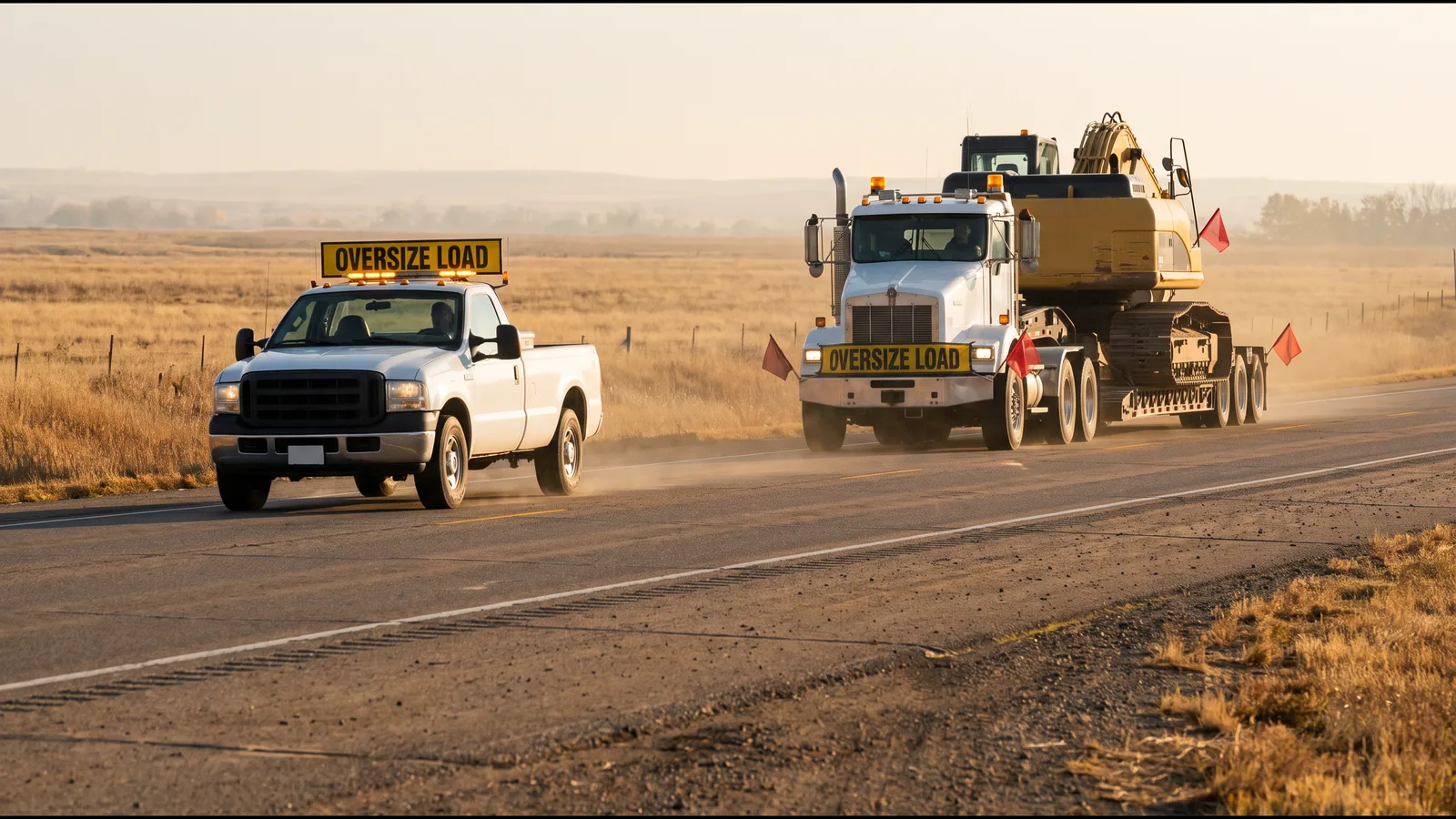
There is no national pilot car rule. Each state sets its own escort triggers by width, height and length, and the numbers don't line up: a 13'6" wide load needs no escort in Texas, one in Florida and Pennsylvania, and two on a Washington two-lane. The permit says how many. The escorts have to match it.
The question our desk hears is "do I need a pilot car?" The honest answer is "in which state, on which road?" Here is how four states with very different rules handle it, when a pilot car becomes a police escort, what the escort vehicle itself has to carry, and the ways a move with escorts still gets parked. Every number below was checked against the state's own rule or page on November 8, 2026.
In this article
- Why the answer changes at the state line
- Escort triggers in four states
- Two-lane or multilane: the road decides the count
- When a pilot car becomes a police escort
- What the escort vehicle has to carry
- Who can drive it: certification
- Five ways a move with escorts still gets parked
- How we match the escorts to the permit
- Questions drivers ask us
1Why the answer changes at the state line
Federal rules set the 102-inch (8'6") width that trucks run on the National Network, but it says nothing about when an oversize load needs an escort. That is left to each state, and in some states to the county or city as well. The Federal Highway Administration publishes best-practice guidelines for escort operators, but guidelines aren't a regulation. The state you're standing in writes the rule that gets enforced.
So a dispatcher who learned the rules in Texas is in for a surprise in Florida. Texas lets a load run up to 14 feet wide with no escort. Florida wants one past 12 feet. Neither is wrong; they drew the line in different places.
2Escort triggers in four states
Here is what four states publish today. "Front" means a lead car, "rear" means a chase car. Where the rule depends on the road, the table says so.
| State | Width | Height | Length |
|---|---|---|---|
| Texas | Over 14' to 16': one front on a two-lane, or one rear on a multilane. Over 16': front and rear on all roads. | Over 17': one front with a height pole. Over 18': front and rear, front with the pole. | Over 110' to 125': one front on a two-lane, or one rear on a multilane. Over 125': front and rear. |
| Florida | Over 12' to 14': one escort. Over 14' to 16': two, front and rear. Over 16': local moves only. | Over 14'6" to 16': one escort ahead with a height indicator. Over 16': a law enforcement escort plus a qualified escort. | Over 95': one. Over 150': two (one on a limited access road). Over 250': law enforcement plus a qualified escort. |
| Washington | Over 11' on a two-lane: two, front and rear. Over 14' on a multilane: one rear. Over 20' on a multilane undivided: front and rear. | Over 14'6": one front with a height pole, on all highways. | Over 105' on a two-lane: one rear. Over 125' on a multilane: one rear. |
| Pennsylvania | Over 13': one, following on a multilane, leading on a single lane in your direction. | Over 14'6": one ahead with a height pole, 1,000 to 3,000 feet in front. | Over 90', or more than 15' of load past the rear: one following, on all highways. |
Now run one load through all four. Take a 13'6" wide excavator on a lowboy, legal height, 80 feet long. Texas: no escort. Florida: one. Pennsylvania: one, following on the interstate. Washington: none on a multilane highway, but two, front and rear, the moment the route drops to a two-lane road. Same load, same week, four different answers.
Overhang and combinations add their own triggers. Texas puts a rear escort on any load with more than 20 feet of front or rear overhang, and says that "if a load exceeds escort requirements in two dimensions, front and rear escorts are required." Washington adds a rear escort on any highway when the driver can't see 200 feet behind in the mirrors.
3Two-lane or multilane: the road decides the count
Notice how often the table says "two-lane" or "multilane." On a multilane highway, traffic coming the other way is on the far side of a median or at least another lane. On a two-lane road, a 13-foot load is in the oncoming lane, and the lead car's job is to warn that traffic before it meets the load on a curve.
That is why Washington wants two escorts over 11 feet wide on a two-lane, while the same load runs alone on a multilane highway until it passes 14 feet. Texas, between 14 and 16 feet, puts the one escort in front on a two-lane and behind on a multilane.
So the escort count belongs to the route, not just the load. A detour off the interstate can need an escort the interstate didn't, which is why our route consulting looks at the road class on every leg, not just the miles.
4When a pilot car becomes a police escort
Past a certain size, states stop trusting private escorts alone and put an officer on the move. The triggers are high, and they vary as much as the pilot car rules do.
- Florida requires a law enforcement escort, in addition to a qualified escort, for loads over 16 feet high and for loads over 250 feet long. Over 16 feet wide, the move is limited to local moves, and on state-maintained roads other than limited access highways it takes two law enforcement escorts at all times. At night, Florida lets a permitted load cross the Alabama line on I-10, to or from the Pensacola weigh station, only with a law enforcement escort.
- Pennsylvania requires a uniformed State Police or local police escort for buildings more than 16 feet wide and for superloads. When the State Police are needed, the Central Permit Office notifies them at least 24 hours before the move starts, and a pilot car still follows the load.
- Texas keeps it open: in addition to private escorts, TxDMV "may require you to obtain law enforcement escorts" for a permitted load. When it does, the permit says so.
In every one of those rules, the officer rides with the qualified escorts, not instead of them. Loads big enough to need police are usually superload territory, and our oversize versus superload post explains where that line sits.
5What the escort vehicle has to carry
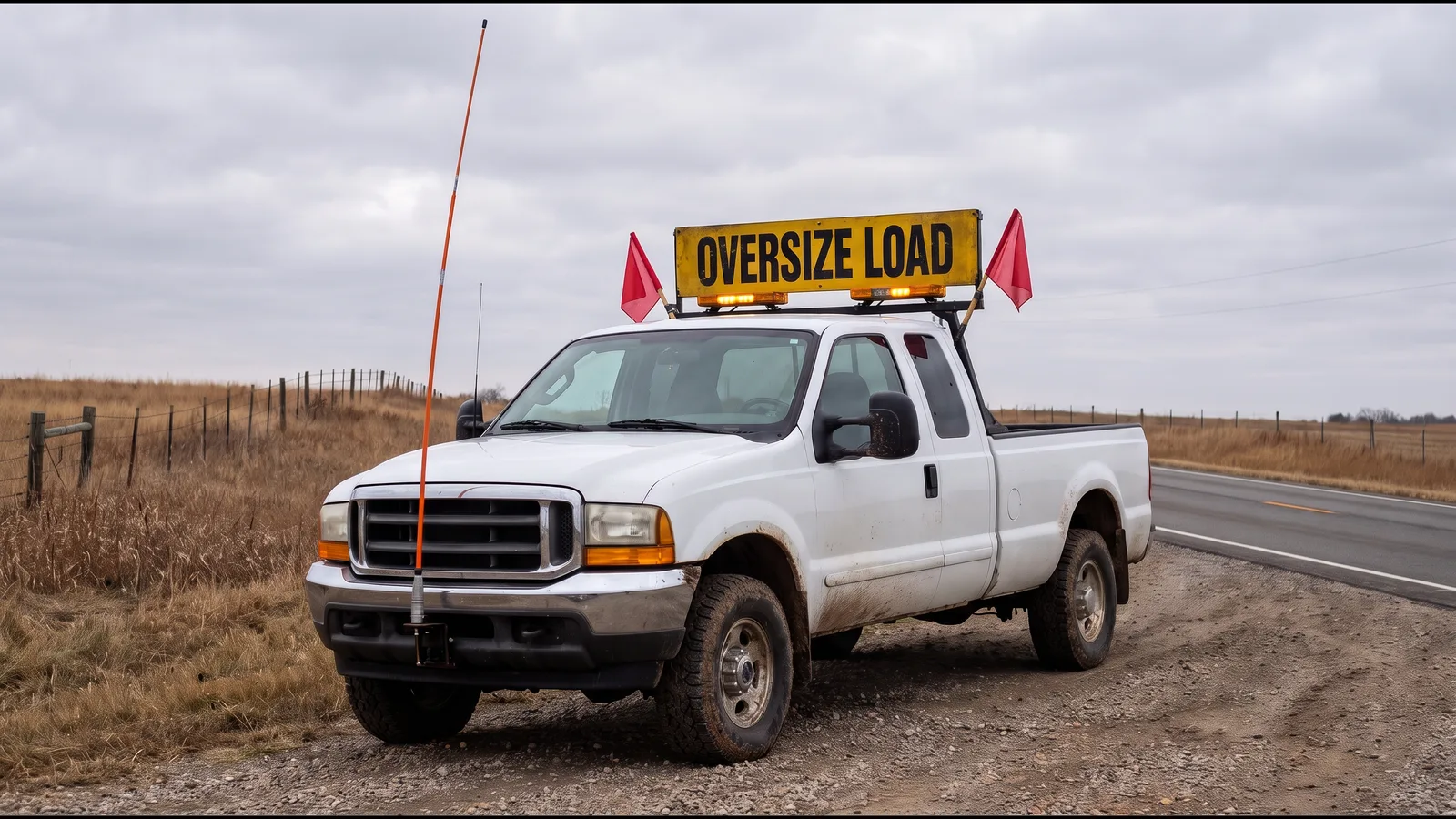
A pickup with a light bar isn't automatically an escort vehicle. Each state writes its own equipment list, and an escort that's legal in one state can be short of gear in the next.
- The sign. Black "OVERSIZE LOAD" on yellow everywhere, but sizes differ. Washington wants at least 5 feet wide by 10 inches high, mounted over the roof. Texas wants 5 to 7 feet long, 12 to 18 inches high, with 8 to 10 inch letters. Pennsylvania wants at least 5 feet by 1 foot with 8 inch letters, on both the front and the rear of the pilot car. Florida wants letters at least 10 inches high with a 1½ inch brush stroke, mounted on the bumper or roof.
- The lights. Washington and Florida both want amber lights visible from at least 500 feet. Texas asks for two flashing amber lights, a rotating amber beacon at least 8 inches across, or alternating blue and amber lights on the roof. Pennsylvania wants one or two flashing or revolving amber lights running the whole move.
- The flags. Florida wants two red or fluorescent orange flags, at least 18 by 18 inches, on the roof rack at a 40 to 70 degree angle.
- The radio. All four states require two-way communication between the escort and the truck.
- The height pole. For tall loads, the lead car carries a nonconductive pole set above the load's height: 3 to 6 inches above it in Washington, at least 6 inches above it in Florida. Texas requires it on the front escort for anything over 17 feet.
- The vehicle itself. Florida requires a single-unit vehicle rated at least 2,000 and under 26,000 pounds GVWR, with name signs on both sides. Texas requires a single unit of 1,000 to 10,000 pounds.
One rule people forget: the sign comes down when the job is over. Washington says the sign must be removed or covered when the car is not escorting, and Texas says the sign "must not be used at any other time." Our older post on pilot car signs by state has more on sign specs.
6Who can drive it: certification
The escort driver needs paperwork too, and not every state accepts every other state's card.
- Washington: certified after department-approved training, eight hours to start and four hours to recertify, with a written test and an 80 percent passing score. Cards renew every three years, and the driver carries the card while escorting.
- Florida: at least 18, a valid license, an eight-hour defensive driving course or a current Class A, B or C CDL, and an eight-hour pilot/escort flagging course, requalified every four years. Out-of-state escorts are accepted only if their state's standards are equal or stricter and they qualified within the past four years. Qualification papers must be ready to show on request.
- Texas: escort flaggers who direct traffic must complete an approved traffic-direction training program, and Texas accepts training another state accepts. Escort drivers who don't direct traffic don't need it.
The question isn't "are you certified?" It's "are you certified for this state?"
7Five ways a move with escorts still gets parked
Pilot cars on the job don't make the move legal by themselves. The five we hear about most:
- The count is right for the last state, not this one. A 13-foot load that ran Texas with no escorts needs one the moment it enters Florida. Read the escort conditions on each state's permit, not the one before it.
- The escort is out of position. Florida says escorts operate no more than 300 feet in front of or behind the load unless conditions or the permit say otherwise. Pennsylvania wants the height pole car 1,000 to 3,000 feet ahead. An escort too far ahead to help, or too close to see a wire before the load hits it, is out of compliance.
- No card for this state. A driver who is certified in a state Florida doesn't recognize is not a qualified escort in Florida. Neither is one who left the card at home.
- The height pole is set to the wrong height. Washington wants the pole 3 to 6 inches above the load, Florida at least 6 inches. A pole set to the trailer height instead of the load height tells the lead car the bridge is fine when it isn't.
- The road changed and the escorts didn't. A detour off the interstate onto a two-lane can add an escort in Texas and Washington. If the permit's route changed, check whether the escort count did too.
Most of these are permit-condition problems, and a load that breaks its permit conditions is treated like a load without one. Our post on seven ways an oversize permit gets voided covers the rest of the list, and the oversize permit checklist has the dimensions we ask for before we order a thing.
8How we match the escorts to the permit
We answer the escort question from the dimensions and the route, state by state: width, height, length, front and rear overhang, and the road class on every leg. We order each state's permit and tell you what its escort conditions say: how many, front or rear, which stretches need a height pole, and where an officer has to be booked ahead. If the route changes mid-trip, we recheck the count.
Start at our pilot cars page. If timing matters, and it always does, check the closure list too: Thanksgiving is November 26, holiday travel restrictions apply whether or not you have escorts, and our Thanksgiving restrictions post has the state-by-state windows.
If you ever need a permit, click to call.
A specialist picks up. Oversize, overweight, superload, trip and fuel permits in every U.S. state and Canadian province.
Call (888) 949-4220Questions drivers ask us
What size load requires a pilot car?
It depends on the state and the road. In the four states we checked, width triggers start over 11 feet on a Washington two-lane, over 12 feet in Florida, over 13 feet in Pennsylvania and over 14 feet in Texas. Height triggers start over 14'6" in Florida, Washington and Pennsylvania, and over 17 feet in Texas.
Is there a federal pilot car requirement?
No. Federal rules set the 102-inch width limit on the National Network, but escort requirements are written by each state. FHWA publishes best-practice guidelines for escort operators, and guidelines are not a regulation.
When does an oversize load need a police escort?
Only at the far end of the scale. Florida requires a law enforcement escort over 16 feet high or 250 feet long, Pennsylvania for buildings over 16 feet wide and for superloads, and Texas when TxDMV puts it on the permit. The police escort rides with the pilot cars, not instead of them.
Does the pilot car go in front or behind?
The road usually decides. On two-lane roads the escort tends to lead, to warn oncoming traffic. On multilane highways it tends to follow. Over the height trigger, all four states we checked put a lead car with a height pole in front.
Is a pilot car certification from one state good in another?
Sometimes. Florida accepts out-of-state escorts only if their state's standards are equal or stricter and they qualified within the past four years. Texas accepts flagger training another state accepts. Check each state on the route before the escort crosses.
Do pilot car signs have to come down after the job?
Yes, in Washington and Texas at least. Washington says the OVERSIZE LOAD sign must be removed or covered when the car is not escorting, and Texas says the sign must not be used at any other time.
Sources
Rules checked November 8, 2026. Penalties change, and the permit in your cab plus the issuing state's current rule are always the final word.
- TxDMV, Escort and Equipment Requirements
- Fla. Admin. Code R. 14-26.012, Movement Conditions and Restrictions (Cornell Legal Information Institute)
- WAC 468-38-100, Pilot/escort vehicles and flaggers (Washington State Legislature)
- 67 Pa. Code section 179.10, Special conditions: escorts and pilot cars (Pennsylvania Code & Bulletin)
- 23 CFR 658.15, Width (Cornell Legal Information Institute)
- FHWA, Pilot/Escort Vehicle Operators Best Practices Guidelines (FHWA-HOP-16-051)