
Winter Oversize Loads: Chain Laws, Short Days and the Weather Rule Already on Your Permit
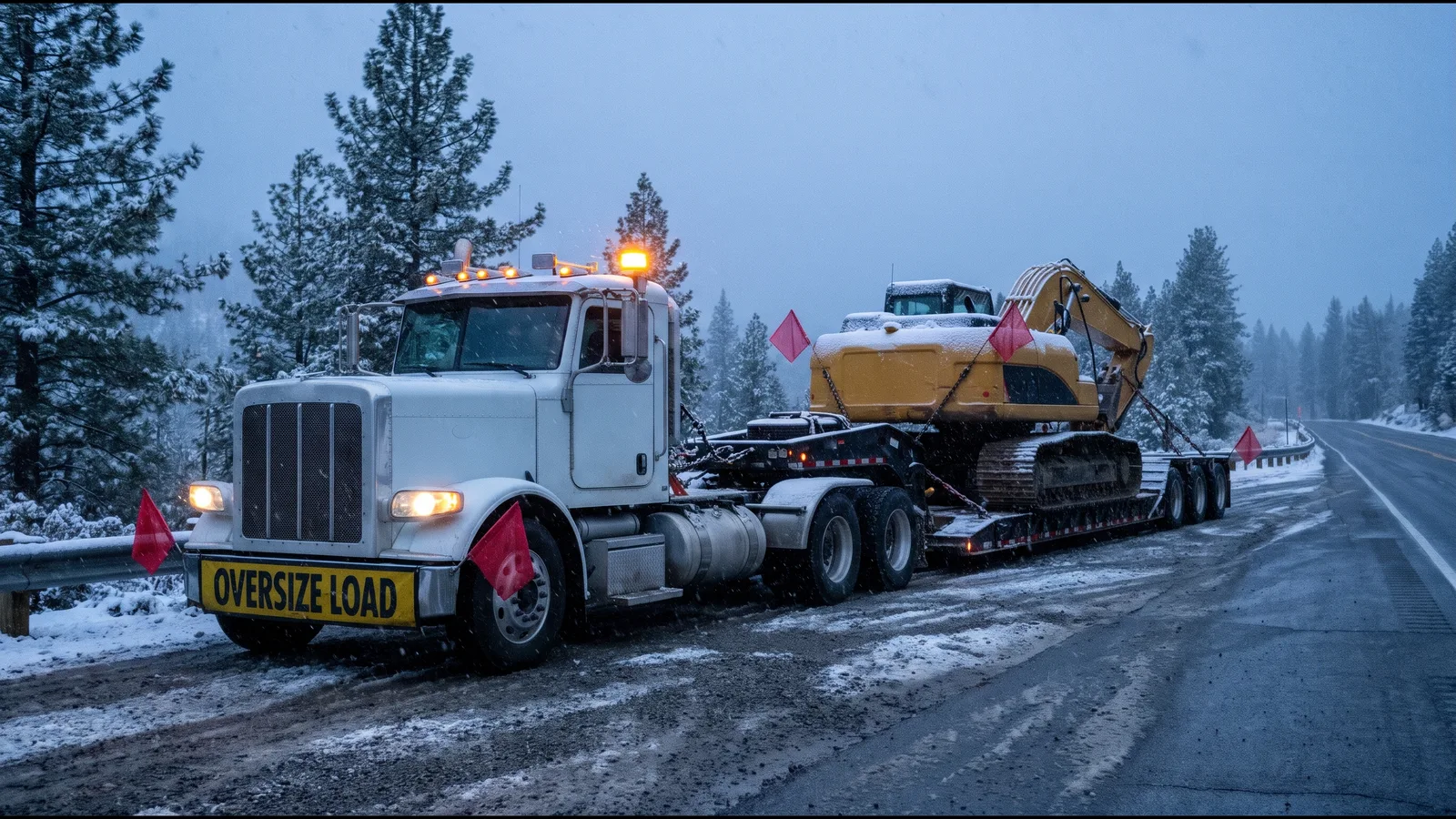
In winter, an oversize permit stops before the truck does. California prohibits permitted movement wherever tire chains are mandatory, Oregon parks anything over 8 feet 6 inches wide on ice, snow or frost, and December leaves about nine hours of daylight to run in.
Chain-law guides are written for every truck on the road. This one is for the load with a permit in the cab, because the permit carries its own winter rules and they are stricter than the chain law. Below: what five states put in writing, where chains help and where they don't, Colorado's winter curfew on I-70, and how short the legal day gets. Every number was checked against the state's own rule or page on November 15, 2026.
In this article
1The weather rule already on your permit
Each of the five states we checked writes a weather stop into its oversize rules. The wording differs, and the difference matters when you are sitting at the bottom of a pass deciding whether to go.
| State | Visibility floor | Road surface |
|---|---|---|
| California | No movement under 1,000 feet in snow, fog, rain or wind | Prohibited when surfaces are hazardous from rain, ice, snow or frost, "or when use of tire chains is mandatory" |
| Washington | No moves when visibility is "one thousand feet or less" | The state can post "traction advisory/ |
| Oregon | Less than 500 feet | Anything over 8'6" wide is prohibited when surfaces are "hazardous due to ice, snow or frost" |
| Colorado | Drivers must weigh "a minimum of 1,000 feet visibility" | No travel when the state gives notice of a hazardous road condition, or when the permittee knows one exists |
| Penn. | Less than 1,000 feet | Snow-covered highways "until pavement has been plowed full width," icy pavement until it "has been cindered or salted" |
Those come from California's Transportation Permit Conditions (item 11), WAC 468-38-095 in Washington, OAR 734-082-0023 in Oregon, rule 405 of Colorado's 2 CCR 601-4, and 67 Pa. Code 179.10 in Pennsylvania. All five are linked at the bottom.
Two things stand out. Oregon's rule isn't about how big the load is. It starts at 8 feet 6 inches, which is every wide load there is. And Pennsylvania doesn't ask whether the road is passable. It asks whether the plow has been across the full width, because a 12-foot load needs the whole lane and the shoulder that's still under snow.
Washington adds one more line: if visibility drops while you are moving, the vehicle "must clear the highway at the nearest safe location." Oregon says the same thing about signs. When the state posts a winter restriction, overwidth movement is prohibited, whatever the pavement looks like to you.
2Chain laws: carrying them is not permission to run
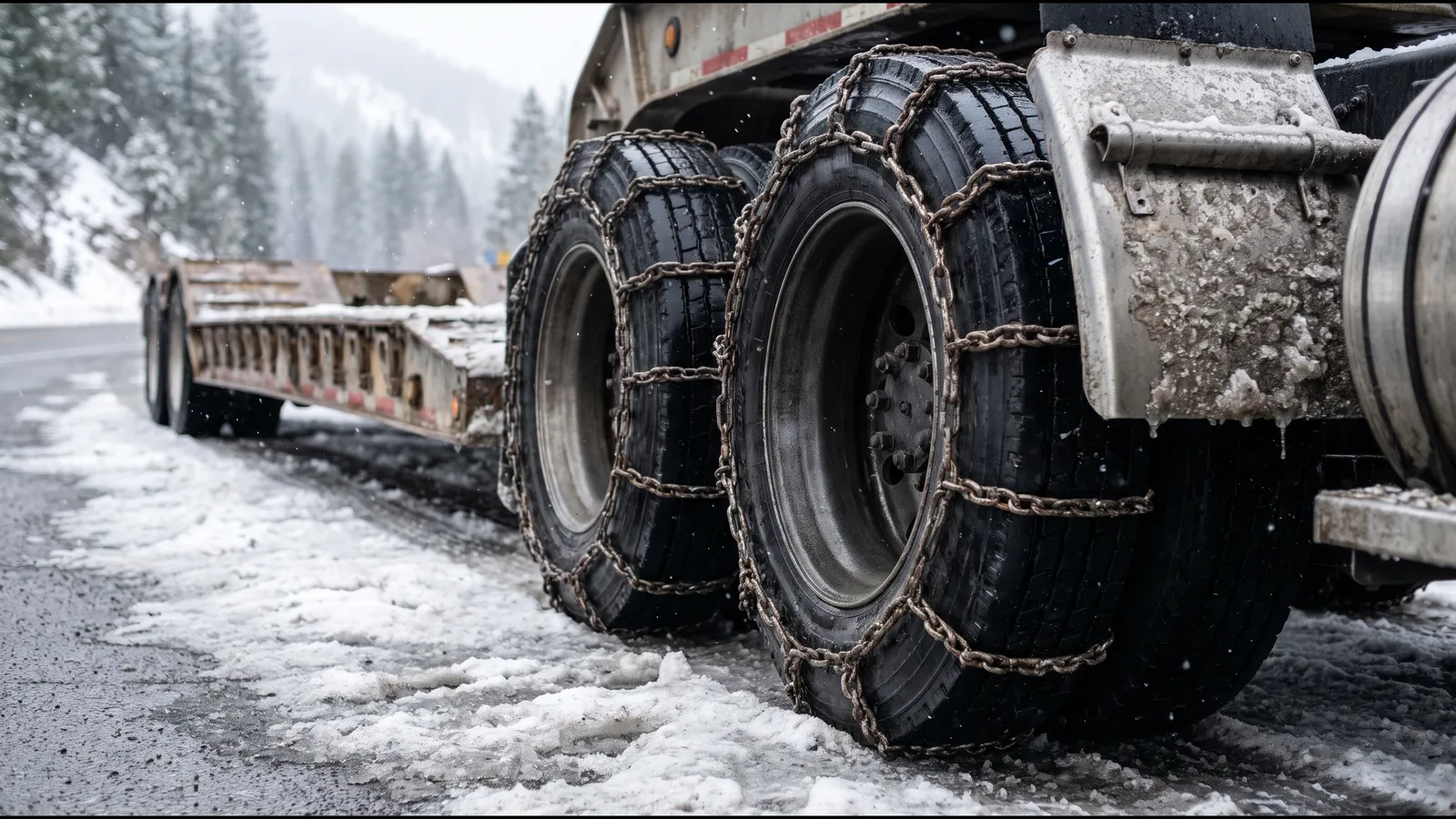
Here is the part that catches people. A legal-size truck reaches a chain control, chains up and keeps going. An oversize load in California reaches the same sign and is done for the day, because the permit condition says movement is prohibited "when use of tire chains is mandatory." Chains on the drives don't change that sentence.
You still have to carry them. What three states require:
- California has no chain season. Caltrans says the state "does not have any specific dates when vehicles are required to carry chains." When the sign is up, every vehicle over 6,500 pounds gross chains up, and snow tires don't count on a heavy truck. During storms Caltrans screens trucks at the approaches to the major passes and sends the ones without chains back down. It lists I-80 over Donner, I-5 north of Redding, US 50 over Echo Summit, and sometimes SR 58 at Tehachapi, I-15 over Cajon and I-5 over Tejon.
- Washington requires vehicles over 10,000 pounds GVWR to carry chains from November 1 to April 1 on twelve listed routes, including I-90 between North Bend and Ellensburg, and to carry "a minimum of two extra chains" on top of what the axle count calls for. The same rule says the state or the patrol "may prohibit any vehicle" from a chain control area if it will have trouble getting through safely.
- Colorado requires commercial vehicles to carry chains from September 1 to May 31 on I-70 from Morrison (milepost 259) west to the Utah line and on listed stretches of US 40, 50, 160, 285 and 550 and Colorado 9. When the chain law is on, chains or approved traction devices go on at least four drive wheel tires. Trailers don't need them. CDOT says tire cables and clip-on chains don't qualify on a commercial vehicle.
3The exception: overweight only
If the load is heavy but not wide, tall or long, two states treat it more like an ordinary truck.
Colorado's rule says vehicles that are overweight only "may chain up and continue movement when chain law is in effect," as long as the gross weight is not over 200,000 pounds. Washington exempts a vehicle on an overweight-only permit, inside every legal dimension, from the "oversized vehicles prohibited" sign, provided it "can maintain posted speed limits" and still follows the chain rule.
So the first winter question we ask is what kind of permit the load is on. A 110,000-pound load at legal width and a 12-foot-wide load at legal weight get different answers at the same chain station.
4Colorado's winter curfew on I-70
Colorado also takes weekend hours away from permitted loads on the mountain corridor, snow or no snow. From December 1 to March 31, between West Vail (Exit 173) and Morrison (Exit 259), CDOT's fact sheet lists:
- Westbound: no oversize or overweight travel 3 to 8 p.m. Friday, or 7 a.m. to 12 p.m. Saturday and Sunday.
- Eastbound: no travel 3 to 9 p.m. Saturday and Sunday.
That is the ski traffic. The exemption is narrow: an overweight vehicle of no more than 110,000 pounds, inside every other legal limit, that can hold 40 mph on the flat and 30 on a grade.
Put it together for a wide load headed west out of Denver on a Saturday in late December. The curfew closes the morning until noon. Sunset is about 4:40 p.m. If the chain law comes on over Vail Pass, Colorado's rule lets only overweight-only loads chain up and continue. Some Saturdays there is no window at all, and Monday is the honest answer. Our route consulting is where that conversation happens before the load is promised.
5Short days: the daylight math
Most wide loads are daylight loads. California's permit conditions define darkness as "one-half hour after sunset to one-half hour before sunrise." Washington and Oregon use the same half-hour definition. Pennsylvania's general rule allows no permitted movement from sunset to sunrise. Here is what that leaves on the shortest day of the year, from U.S. Naval Observatory tables.
| City | Sun up to sun down, Dec. 21 | Daylight, Dec. 21 | Daylight, June 21 |
|---|---|---|---|
| Seattle | 7:55 to 4:20 | 8 hr 25 min | 15 hr 59 min |
| Portland | 7:48 to 4:30 | 8 hr 42 min | 15 hr 41 min |
| Harrisburg | 7:27 to 4:45 | 9 hr 18 min | 15 hr 3 min |
| Denver | 7:18 to 4:39 | 9 hr 21 min | 14 hr 59 min |
| Sacramento | 7:20 to 4:48 | 9 hr 28 min | 14 hr 52 min |
A daylight-only load out of Seattle has seven and a half fewer hours in December than in June. A run that fits in one long summer day becomes two winter days, with a place to park a wide load overnight in between. That parking spot has to be found before the truck leaves, not at 4 p.m.
Not every load is daylight-only. The night rules, in brief:
- Washington: a load inside 12 feet wide, 14 feet 6 inches high and 105 feet long may move at night. Bigger than that, the permit has to say night movement is approved.
- Oregon: non-divisible loads up to 12 feet wide may run during darkness on interstates, and up to 10 feet wide on the other routes marked green on the state's Route Map 2.
- Colorado: over 14 feet wide, no travel in the hours of darkness without a special permit. Between 12 and 14 feet, night travel needs a pilot escort, in front on a two-lane and behind on a four-lane.
Our post on pilot car requirements by state has the escort triggers, and the older oversize travel restrictions guide covers curfews and weekend rules. For Pennsylvania's windows there is a separate post on Pennsylvania oversize regulations.
6Who makes the call, and what it costs
Nobody from the state rides along. The rules put the decision on the driver first.
- Oregon: "It is the driver's responsibility to determine if local road conditions are hazardous," unless ODOT has closed the road or posted it.
- Colorado: the load is prohibited when the state gives notice of a hazard, and also when "the Permittee knows that a hazardous road condition exists." If the route is hazardous, the permittee (annual permit holders excepted) contacts the nearest Port of Entry, the State Patrol or CDOT to ask about an alternate route. If there isn't one, the load "shall not travel until the hazardous road condition ceases to exist."
- Washington: an officer may order a permitted vehicle off the highway when conditions become unsafe, and escort it to a place to park.
- California: "Any crash caused by excessive wind or weather conditions shall be considered a prima facie violation" of the permit condition.
One more caution from Oregon: chain-up areas "are not intended to serve as staging areas for over-dimension loads," and parking in them is prohibited. Waiting out the storm in the chain-up lane is its own violation.
7How we plan a winter move
The permit is dated, and the weather doesn't care. Pennsylvania's single-trip permit, for one, "expires after 5 authorized weekdays have lapsed." Two days parked for a storm are two of those days. So in winter we ask a few extra questions when you call:
- What is over legal? Weight only, or size too. Section 3 is why.
- Which passes are on the route? If there is a lower route that adds miles and skips the chain controls, we'd rather permit that one than watch the load sit at the bottom of the high one.
- How many daylight hours does each leg have? We plan to the sunset in the table above, not to the driver's clock.
- Where does it park? Overnight, and if the pass closes at noon.
- What else closes that week? Winter storms and holiday restrictions stack. Thanksgiving is November 26, with Christmas and New Year's a month behind it. Check the closure list and our Thanksgiving restrictions post before you promise a date.
If a storm does eat the permit dates, call before the permit runs out, not after. What a state will do about dates is up to that state. Our posts on how long an oversize permit really takes and the permit checklist cover the lead time for a re-order, and oversize and overweight permitting is where every one of these loads starts. An older post of ours has general winter operating advice for the truck itself.
If you ever need a permit, click to call.
A specialist picks up. Oversize, overweight, superload, trip and fuel permits in every U.S. state and Canadian province.
Call (888) 949-4220Questions drivers ask us
Can an oversize load travel when chains are required?
In California, no. The state's permit conditions prohibit movement when use of tire chains is mandatory. Washington can post chain control areas as closed to oversized vehicles, and Colorado stops extra-legal loads when a hazardous road condition exists. Loads that are overweight only get more room in Colorado and Washington.
Do oversize loads have to carry chains?
Yes, where the state requires it of commercial vehicles. Colorado requires chains on board from September 1 to May 31 on I-70 west of Morrison and other listed mountain routes. Washington requires them from November 1 to April 1 on twelve listed routes, plus two extra chains. California has no dates, and requires chains whenever the control is posted.
How low can visibility get before an oversize load has to stop?
California and Pennsylvania stop movement when visibility is under 1,000 feet, and Washington at 1,000 feet or less. Oregon's rule is less than 500 feet. Colorado tells drivers to weigh a minimum of 1,000 feet of visibility in the decision to travel.
Can oversize loads travel at night in winter?
Smaller ones, in some states. Washington allows night moves inside 12 feet wide, 14 feet 6 inches high and 105 feet long. Oregon allows non-divisible loads up to 12 feet wide on interstates during darkness. Colorado bars loads over 14 feet wide at night without a special permit, and Pennsylvania's general rule is no movement from sunset to sunrise.
What is the Colorado I-70 winter restriction for oversize loads?
From December 1 to March 31, between West Vail (Exit 173) and Morrison (Exit 259), permitted loads can't travel westbound 3 to 8 p.m. Friday or 7 a.m. to noon on Saturday and Sunday, or eastbound 3 to 9 p.m. Saturday and Sunday. Overweight-only vehicles up to 110,000 pounds that can hold speed are exempt.
Who decides whether the road is too bad for an oversize load?
The driver, until the state decides first. Oregon says it is the driver's responsibility to determine whether local conditions are hazardous unless ODOT has closed or posted the road. In Washington an officer can order a permitted load off the highway when conditions become unsafe.
Sources
Rules checked November 15, 2026. Penalties change, and the permit in your cab plus the issuing state's current rule are always the final word.
- Caltrans, Transportation Permit Conditions (revised December 2025), items 11 and 20
- Caltrans, Truck Chain Requirements
- WAC 468-38-095, Emergency road restrictions due to weather or other conditions (Washington State Legislature)
- WAC 468-38-075, Special permit exemptions for authorized vehicles and/or loads
- WAC 204-24-050, Use of tire chains or other traction devices
- WSDOT, Curfew hours and holiday restrictions (nighttime movements)
- OAR 734-082-0023, Weather Restrictions (Cornell Legal Information Institute)
- Oregon DOT Commerce and Compliance Division, Oregon Travel Restrictions
- 2 CCR 601-4, chapter 4, Transport Permit Operating Requirements and Restrictions, rules 405 and 408.3 (Cornell Legal Information Institute)
- Colorado DOT Freight, Chain Law fact sheet (August 2026)
- Colorado DOT Freight, Mountain Rules: Chain Law one-pager (must-carry routes and fines)
- 67 Pa. Code section 179.10, General conditions (Pennsylvania Code & Bulletin)
- U.S. Naval Observatory, Sun or Moon Rise/Set Table for One Day (December 21 and June 21, 2026)